Money Market Account vs High-Yield Savings: Avoid These Costly Mistakes
You’ve got $10,000 sitting in a regular savings account earning 0.01% annually. That’s roughly $1 per year while inflation eats away 3-4% of your purchasing power. You know you need a better home for this money—but should it go into a money market account or a high-yield savings account? Most people get this wrong, and it costs them hundreds or even thousands in missed gains and unnecessary fees.
Why this matters: Choosing the wrong account type can lock your money away when you need it or saddle you with surprise fees that erode your returns. The difference between a 4.5% APY and a 3.2% APY compounds to real money over time. We covered How to Build an Emergency Fund: A Step-by-Step Guide for 202 in detail elsewhere.
The mistake isn’t choosing between two bad options—it’s not understanding how each account actually works before you commit. The decision feels straightforward until you actually open one, and most people stumble not because the products are complex, but because they misunderstand what each account demands and delivers. This article walks you through the most common errors savers make and the straightforward fixes that get you into the right account faster.
Mistake #1: Confusing Money Market Accounts With Money Market Funds
This is the biggest trap. A money market account (MMA) is an FDIC-insured deposit account at a bank or credit union. A money market fund is an investment product—not insured by the FDIC—that invests in short-term debt securities. They sound identical. They are not.
When you open a money market account at your bank, your deposits are protected up to $250,000 by federal insurance. If the bank fails, you don’t lose your money. With a money market fund through a brokerage, there’s no FDIC safety net. Your investment value can fluctuate, and in rare cases of fund collapse, recovery is uncertain.
The fix: Always confirm the institution type. If you’re opening through a traditional bank or credit union, you’re getting an MMA (insured). If a brokerage offers it, you’re likely looking at a fund. Check the account documentation for the phrase “FDIC insured” or “Member FDIC.” According to the FDIC’s official guidance, only deposits at insured institutions carry the guarantee.
Mistake #2: Ignoring the Withdrawal Limits That Can Lock Your Money
Historically, money market accounts came with strict limits on how many times per month you could withdraw funds—often capped at 3 to 6 transactions under Regulation D. Banks used these rules to keep funds stable and predictable. Many savers learned this the hard way when they needed cash and discovered their account wouldn’t let them access it without penalties.
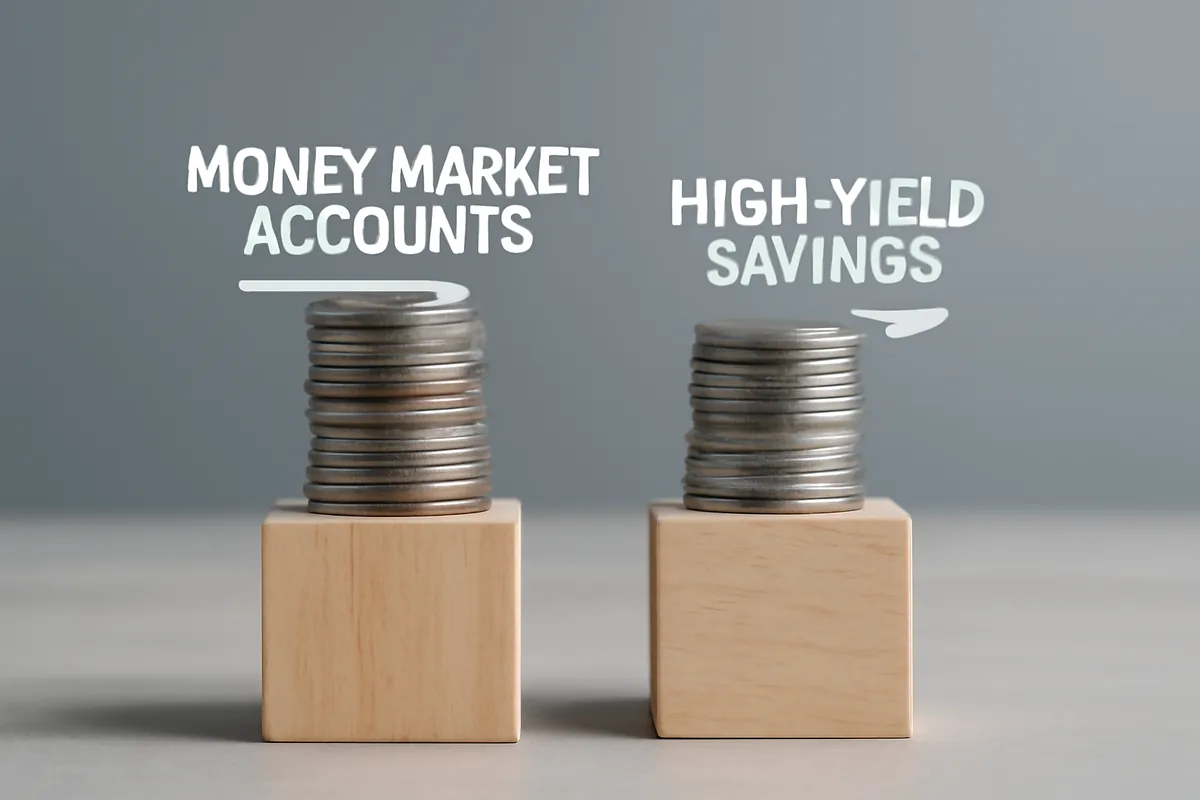
Regulation D’s six-per-statement-cycle limit was relaxed after the pandemic, and high-yield savings accounts now typically allow unlimited transfers and withdrawals in 2026. Money market accounts have loosened restrictions too, but many banks have quietly reintroduced limits—some cap transfers at three per month, others at four—and charge $10-35 for each excess withdrawal.
If you’re building an emergency fund or anticipate needing quick access, these limits matter. If you need to tap your emergency fund twice in a month and hit your limit, you’ll either pay a $25-$35 excess withdrawal fee or face a delayed transaction that compounds your financial stress when you need liquidity most.
The fix: Before opening any account, call the bank or check the terms for “transaction limits” or “withdrawal frequency rules,” and request the written policy. Count how many times per month you anticipate moving money. If it’s more than three, a standard high-yield savings account with no withdrawal caps makes more sense, even at a marginally lower rate. If you rarely touch the money, an MMA’s slightly higher rate (often 0.25-0.5% more) might justify any restrictions.
Mistake #3: Not Comparing APY Across Banks
The term “high-yield” suggests a standardized category. In reality, rates vary wildly across institutions. In 2026, high-yield savings accounts at online banks range from 4.25% to 5.35% APY, while some regional banks lag at 3.8% and traditional brick-and-mortar banks offer as little as 1.2%. Over five years on a $10,000 balance, the gap between 4.5% and 1.2% amounts to roughly $1,800 in extra earnings.
Many savers stick with their current bank out of habit, never realizing they’re leaving thousands on the table. Banks compete harder for deposits from new customers, so online banks and regional institutions often beat national chains. Others compare accounts without checking whether they’re looking at the current rate or a promotional teaser rate that expires after six months. Moving $50,000 to an account earning 4.5% instead of 5.1%, for example, costs you roughly $300 annually—$1,500 over five years.
The fix: Spend 15 minutes comparing rates across at least three institutions. Use rate-tracking sites like DepositAccounts.com or Bankrate.com, but verify the rates directly on the bank’s website—some aggregators lag behind. Confirm the APY is not a limited-time offer, and look for banks with no monthly fees, no minimum balance requirements, and FDIC insurance. A higher rate doesn’t matter if fees eat your gains. Set a calendar reminder to review rates annually; as rates shift, so should your money.
Mistake #4: Underestimating How Quickly Rates Change
The Federal Reserve controls the benchmark interest rate. When it rises, banks raise APYs on savings products. When it falls, banks cut rates—sometimes within days. Interest rates for both account types adjust frequently, and in 2026 they range from roughly 4.50% to 5.35% depending on the institution and account structure. We covered our guide on High-Yield Savings Accounts Comparison 2026: Rates, Fees � in detail elsewhere. We covered this analysis of Do High-Yield Savings Accounts Have Withdrawal Limits? What in detail elsewhere.
The mistake is thinking the advertised rate is guaranteed for a year. Rates reset monthly or quarterly for most providers. If you lock yourself into a one-year promotional rate without understanding what happens when the promo ends, you might wake up to a rate that dropped 1-2 percentage points. A 4.5% APY becomes 2.5% overnight, and you’re stuck unless you move your money to a new bank.
The fix: Read the fine print on promotional rates. Check whether your rate is variable or fixed and for how long, and know what the standard rate will be once any promotion ends. Most high-yield savings accounts adjust rates automatically with the market—no action needed. If you’re earning a competitive rate at a stable institution with no early-closure penalties, you’re in good shape to switch later if rates elsewhere improve.
Mistake #5: Confusing Tiered Rates With Genuine Account Tiers
Some money market accounts advertise tiered rates: 5.0% on balances under $10,000, 5.2% on $10,000-$50,000, and 5.35% above $50,000. People assume this rewards larger deposits proportionally, expecting the top rate to apply to their whole balance. What actually happens is that only the portion that fits each tier earns that tier’s rate.
Consider a $75,000 deposit: it might earn 5.0% on the first $10,000 ($500), 5.2% on the next $40,000 ($2,080), and 5.35% on the remaining $25,000 ($1,337.50), totaling $3,917.50 annually—not the $4,012.50 you’d get if the full amount earned 5.35%.
The fix: Calculate the blended rate yourself using a simple spreadsheet. Plug in the tier breakpoints and multiply each portion by its rate. Compare this realistic figure against flat-rate accounts that may offer 5.15-5.25% on all balances.
Mistake #6: Neglecting to Compare FDIC Limits Across Multiple Accounts
Federal deposit insurance covers up to $250,000 per depositor, per insured bank, as of 2026. Someone with $500,000 might park all of it in one institution’s high-yield savings account, believing they’re fully protected. They are not—and holding multiple accounts at the same institution doesn’t help, because they generally count against a single coverage limit.
In a bank failure, only $250,000 would be insured. The remaining $250,000 becomes an unsecured claim, likely resulting in substantial loss.
The fix: Spread deposits across multiple FDIC-insured banks—for instance, open accounts at two separate institutions, each holding $250,000. Money market accounts at different banks are separately insured. Use the FDIC’s Electronic Deposit Insurance Estimator (EDIE) tool before depositing large sums to confirm your coverage.
Bank marketing materials sometimes display rates confusingly. Annual Percentage Yield (APY) is the standard metric you should use, because it accounts for compounding over a full year. Avoid accounts that quote monthly rates—these are often presented to inflate the apparent return and make one account look better than a competitor that quotes APY honestly.
- Compare APY rates: Check at least three providers. Use online aggregators like Bankrate or DepositAccounts to verify current 2026 rates.
- Confirm withdrawal rules: Email customer service asking about monthly transaction limits and associated fees.
- Verify FDIC status: Ensure the bank is FDIC-insured and check your total coverage across all accounts.
- Read the fee schedule: Request a full disclosure document before signing up.
- Check rate adjustment frequency: Ask whether rates reset monthly, quarterly, or annually.
- Test customer service: Call or chat with support to gauge responsiveness—you’ll rely on them if issues arise.
- Track your account: Set calendar reminders to review your balance and rate quarterly.
How to Recover if You’ve Already Made a Mistake
If you’re paying excessive fees: Many banks will waive one or two fees if you request it politely. Document the charges and call the account manager. If denied, escalate to the customer advocate.
If your rate dropped significantly: You can transfer your funds to a higher-yielding account at another bank without penalty (transfers take 3-5 business days). Federal regulations protect you from early-withdrawal penalties on savings accounts.
If you’re caught with coverage gaps: Immediately open an account at a different FDIC-insured bank for excess funds. The FDIC recognizes accounts opened on the same day as separate for coverage purposes.
If withdrawal limits are too restrictive: Request a limit increase from your bank. Most will accommodate savers with consistent balances above $10,000.