Got $50 sitting in your checking account and wondering if that’s enough to actually invest? Here’s the thing—it absolutely is. The old myth that you need thousands of dollars to get started died years ago. Today, you can open a brokerage account with literally $1 and start building wealth. No trust fund required; no finance degree needed.
This guide walks you through exactly how to begin investing when your budget is tight. No jargon, no judgment—just practical steps. We covered this analysis of How to Invest in Your 20s: A Step-by-Step Beginner’s G in detail elsewhere.
In simple terms: Investing with little money means putting small amounts—sometimes as little as $1 to $100—into stocks, funds, or other assets using modern apps and strategies designed specifically for beginners with limited cash.
Why Starting Small Actually Matters
You might think, “What’s the point of investing $25?” Fair question.
But here’s what most people miss: time beats amount, almost every single time. A 25-year-old who invests $50 per month will likely end up with more money at retirement than a 45-year-old who invests $200 per month. That’s compound interest doing its thing—your money earns returns, then those returns earn returns. According to the U.S. Securities and Exchange Commission, starting early—even with small amounts—is one of the most powerful wealth-building strategies available to everyday Americans.
And there’s a psychological benefit too. Investing $20 this week builds the habit. Next month, maybe it’s $40. The muscle memory matters more than the dollar amount when you’re just getting started.
What Is an Investment, Really?
Strip away the jargon, and investing is simply putting your money to work so it can grow without you trading more hours. Think of it like planting an apple tree. You spend a little money on a sapling today, water it occasionally, and years later it produces fruit—not because you worked harder, but because time and nature did the heavy lifting. Your initial $50 or $100 functions the same way when invested wisely.

Photo by www.kaboompics.com on Pexels
The mechanism behind this growth involves ownership. When you buy a stock, you own a tiny slice of a real company. When that company profits, your slice becomes more valuable. When you buy a bond, you’re lending money to a government or corporation, and they pay you interest for the privilege. Either way, your money participates in economic activity that generates returns over time.
Example: Say you invest $25 into a broad stock market index fund. You now own microscopic pieces of hundreds of companies—Apple, your local grocery chain’s parent company, pharmaceutical firms developing new medications. When Americans buy iPhones or fill prescriptions, some of that economic activity flows back to you as an owner.
Watch out: Investing isn’t saving. Savings accounts preserve your money with minimal risk and minimal growth—around 4-5% APY in high-yield accounts as of 2026. Investments can grow significantly faster over decades, but they fluctuate in value. Money you might need within the next one to two years belongs in savings, not investments.
The Basics: What You’re Actually Buying
Before you tap “buy” on any app, let’s clarify what you’re purchasing. This isn’t complicated—but it does require knowing a few terms.
Stocks
When you buy a stock, you own a tiny piece of a company. Buy one share of Apple, and you’re technically a part-owner of Apple. If the company grows and profits increase, your share typically becomes more valuable. If the company struggles? Your share loses value.
Single stocks can be risky. One bad earnings report, and your investment drops 15% overnight. That’s why most beginners don’t start here.
Index Funds and ETFs
This is where most financial advisors point new investors—and for good reason.
An index fund or ETF (exchange-traded fund) bundles hundreds or thousands of stocks into one purchase. Buy a total stock market ETF, and you instantly own tiny pieces of over 3,000 companies. One investment; massive diversification.
The S&P 500—which tracks 500 of America’s largest companies—has historically returned about 10% annually over the long term, according to data from S&P Global. No guarantees for the future, but that historical context matters.
ETFs trade like stocks throughout the day. Index mutual funds price once daily. Both work fine for beginners; ETFs just offer more flexibility. (Related: Debt Snowball vs Debt Avalanche: A Beginner’s Guide to.)
Fractional Shares
Here’s the game-changer for small-budget investors.
Amazon stock costs over $180 per share in 2026. Can’t afford that? No problem. Fractional shares let you buy $10 worth of Amazon—you’d own roughly 0.055 shares. It’s real ownership, just smaller slices.
Most major brokerages now offer fractional investing: Fidelity, Charles Schwab, and apps like Robinhood and Acorns all support it. This feature didn’t exist for regular investors a decade ago; it’s genuinely democratized access to expensive stocks.
What About Bonds and Crypto?
Bonds are essentially loans you give to governments or corporations—they pay you interest. They’re generally safer but offer lower returns. For beginners with small amounts, stock-focused ETFs typically make more sense because you need growth, not preservation.
Crypto? That’s a different conversation entirely. High risk, high volatility. If you’re learning to invest, master the basics first. Speculation can wait.
Compound Growth: The Engine Behind Small-Dollar Wealth
Understanding what investments are provides the foundation, but compound growth is where modest contributions transform into something substantial. Compound growth means your earnings generate their own earnings. It’s not just your original $50 growing—it’s your $50 plus last year’s gains plus the year before that, all snowballing together.
Imagine a snowball rolling downhill. At first, it’s small and picks up only a thin layer of snow with each rotation. But as it grows larger, each rotation captures more surface area, adding snow faster. Your investments work identically—the larger your balance becomes, the more powerful each percentage gain feels in dollar terms.
Example: If you invest $100 monthly starting at age 25 and earn an average 7% annual return, you’d have approximately $264,000 by age 65. But here’s the astonishing part: you only contributed $48,000 of your own money. The remaining $216,000 came purely from compound growth—money your money made.
Watch out: Compound growth requires patience measured in years, not months. Checking your account weekly and panicking during downturns interrupts the compounding process. The snowball needs continuous rolling time to reach meaningful size.
Index Funds: The Beginner’s Best Friend
Rather than picking individual stocks—a game where even professional fund managers frequently lose to the market—index funds let you own a basket of hundreds or thousands of companies in one purchase. An S&P 500 index fund, for instance, automatically includes the 500 largest U.S. public companies, weighted by their size.
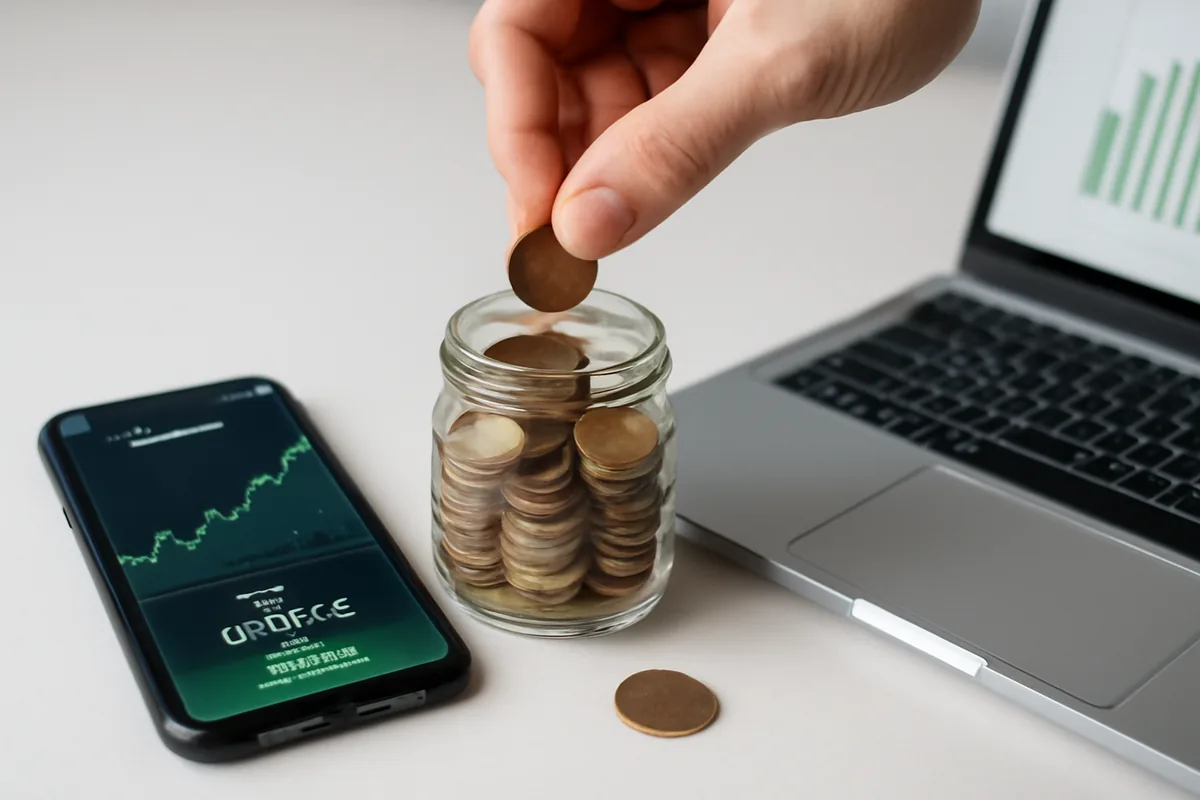
Think of index funds like buying the entire farmers market instead of guessing which single vendor will have the best tomatoes. Some vendors will disappoint, others will exceed expectations, but collectively you capture the market’s overall bounty without the stress of picking winners.
Example: Fidelity’s FXAIX and Vanguard’s VOO both track the S&P 500 with expense ratios below 0.04%—meaning you pay less than $4 annually per $10,000 invested. Through apps like Fidelity or Schwab in 2026, you can buy fractional shares of these funds starting at $1.
Watch out: Not all funds are index funds. Actively managed funds charge higher fees—often 0.5% to 1% or more—to pay managers who try to beat the market. Research consistently shows most fail to do so over long periods. Always check the expense ratio before investing.
Your First Steps to Investing
Moving from saving to investing can feel like a huge leap, but it breaks down into a few manageable steps. The key isn’t to be perfect, but to begin. Here’s how you can make your first investment, even this week.

Photo by Vitaly Gariev on Unsplash
- Define Your Goal and Timeline. Why are you investing? For retirement in 40 years? A house down payment in seven years? Your goal determines your strategy. Long-term goals (10+ years) can tolerate more market fluctuation, making stock-based funds suitable. Shorter-term goals require more conservative investments.
- Choose Your Account Type. For retirement, a Roth IRA is a powerful tool. You contribute after-tax dollars, and your qualified withdrawals in retirement are tax-free. For other goals, a standard taxable brokerage account offers more flexibility. Many people have both.
- Select a Brokerage Firm. In 2026, competition has eliminated most fees for beginners. Major firms like Fidelity, Charles Schwab, and Vanguard offer $0 account minimums, no-commission trades on stocks and ETFs, and user-friendly platforms.
- Fund Your Account. Connect your bank account and make a transfer. Thanks to fractional shares, you don’t need hundreds of dollars. You can start with $50, $25, or even just $5. The most effective action is to set up a recurring automatic transfer, even if it’s small.
- Make Your First Investment. Don’t start with individual stocks. A simple, highly-diversified investment is best. Look for a low-cost, total stock market index fund ETF, such as the Vanguard Total Stock Market ETF (VTI) or the iShares Core S&P Total U.S. Stock Market ETF (ITOT). This single purchase gives you a small piece of thousands of U.S. companies.
Glossary of Key Terms
- Brokerage: A company that facilitates the buying and selling of financial securities for investors.
- ETF (Exchange-Traded Fund): A security that tracks an index, sector, or commodity but trades like a stock on an exchange.
- Index Fund: A fund designed to mirror the performance of a specific market benchmark, like the S&P 500.
- Diversification: The practice of spreading your investments around so that your exposure to any one type of asset is limited.
- Ticker Symbol: A unique series of letters assigned to a security for trading purposes (e.g., VTI).
- Fractional Share: A portion of one share of a company’s stock, allowing investment with smaller amounts of money.
What to Learn Next
Once you’ve opened an account and made your first investment, your journey is just beginning. Building on your initial knowledge is crucial for long-term success. Focus your learning on these core concepts next:
- Asset Allocation: This is the practice of balancing your portfolio between different asset categories, primarily stocks and bonds. Your ideal mix depends on your age, risk tolerance, and investment timeline. A common rule of thumb for beginners was the “110 minus your age” rule to determine your stock percentage, but modern strategies are often more nuanced.
- Dollar-Cost Averaging (DCA): This is the simple strategy of investing a fixed amount of money on a regular schedule, regardless of what the market is doing. It reduces the risk of investing a large sum at a market peak and enforces disciplined, consistent investing habits.
- Understanding Expense Ratios: Every ETF and mutual fund charges an annual management fee called an expense ratio. It’s a small percentage of your investment (e.g., 0.03%). While it seems tiny, this fee compounds over time and can significantly impact your returns. Always favor funds with very low expense ratios.
Conclusion
The most difficult step is the first one. By opening an account and investing a small, manageable amount today, you activate the power of compound growth for your future self. Forget trying to time the market; the most proven strategy for building wealth is consistent investment over a long period. You have the tools and the knowledge—now is the time to begin.